NEWLY DIAGNOSED
Newly Diagnosed Cholangiocarcinoma: First Steps
Newly diagnosed cholangiocarcinoma patients and families need clear next steps early.
This guide explains what to do first after a cholangiocarcinoma or bile duct cancer diagnosis.
Cholangiocarcinoma is bile duct cancer, a cancer that starts in the bile ducts, the tubes that carry bile from the liver to the small bowel.
This page helps you follow the process,
avoid common early mistakes, ask better questions, and keep treatment options open.
STEP 1. Follow the Process
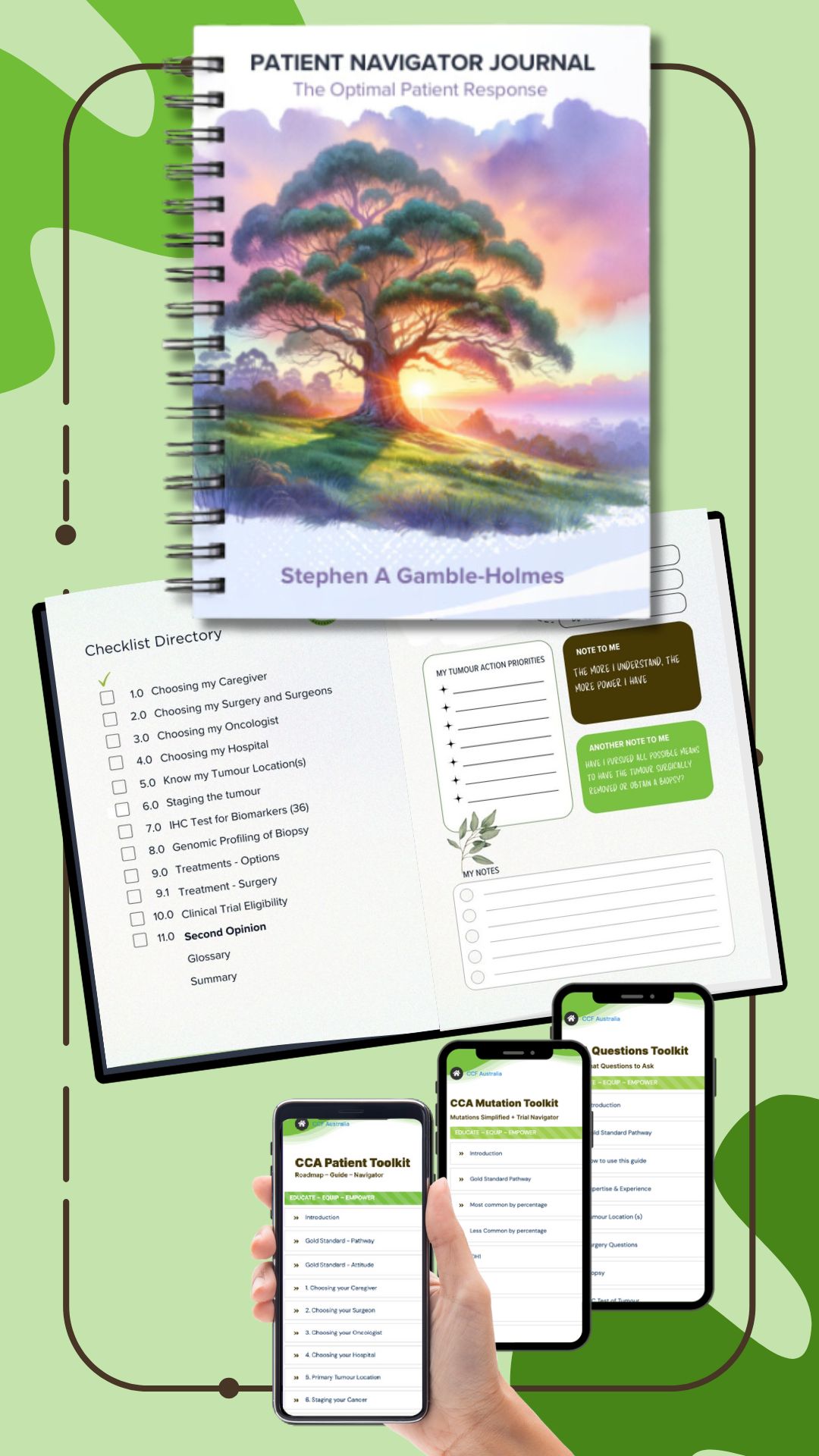
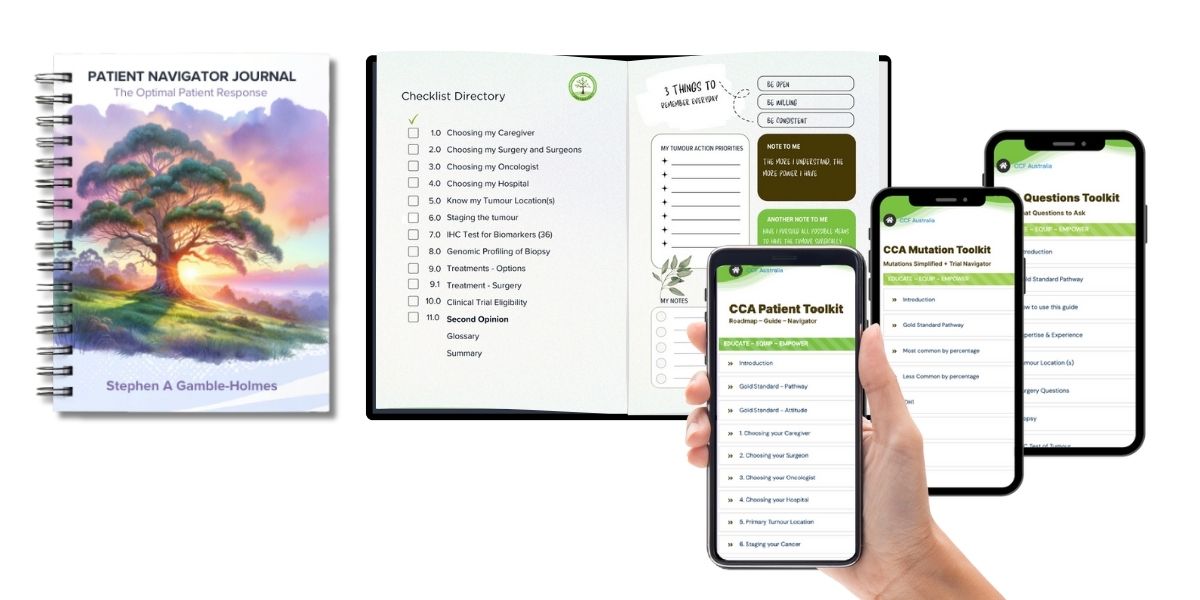
Order Your Patient Navigator Journal
As a newly diagnosed patient, you do not know what you do not know, but you need to know it quickly. The Patient Navigator fills that gap.
The Journal and accompanying mobile app provide a process built on lived experience and clinical guidance.
They help you follow the right steps, avoid common mistakes, understand earlier, keep options open, and build an effective response.
STEP 2. Understand Your Diagnosis
Know Where The Cancer Started
Cholangiocarcinoma is bile duct cancer, but not all bile duct cancers start in the same place.
Ask your doctor where the primary tumour started, because location can affect surgery, stents, biopsy, symptoms, treatment planning, and which specialists should review your case.
Key question to ask:
What type of cholangiocarcinoma do I have, and where exactly did it start?
Cholangiocarcinoma is classified by where it starts in the bile duct system. The National Cancer Institute describes the main locations as intrahepatic bile duct cancer, perihilar bile duct cancer, and distal bile duct cancer.
Intrahepatic cholangiocarcinoma
The liver is constantly making bile.
Inside the liver, many small bile ducts collect that bile and drain it through the liver. These small ducts are called intrahepatic bile ducts.
Think of them as the liver’s internal plumbing network.
Intrahepatic cholangiocarcinoma starts in these bile ducts inside the liver.
Why it matters: this location can affect liver surgery planning, liver-directed treatments, systemic therapy, genomic profiling, and careful review of scans.
Depending on the case, surgical options may include partial hepatectomy, where part of the liver is removed.
Perihilar or hilar cholangiocarcinoma
As bile drains through the liver’s internal plumbing, the smaller ducts join into two larger drainage ducts: the right hepatic duct and the left hepatic duct.
These two ducts leave the liver and meet near the liver’s exit point. Together, they form one larger duct called the common hepatic duct.
Perihilar bile duct cancer, also called hilar cholangiocarcinoma, starts in this joining area. Depending on the case, it may sit below the junction, involve the point where the ducts meet, or extend into the right or left hepatic duct.
This area is sometimes called the liver hilum.
Why it matters: this location can affect bile drainage, jaundice, stenting, surgery planning, and whether an experienced hepatobiliary surgeon who regularly assesses and operates on cholangiocarcinoma patients should review the case early.
Depending on the case, surgical options may include bile duct surgery, liver resection, or highly selected liver transplant pathways.
Distal extrahepatic cholangiocarcinoma
Distal bile duct cancer starts lower down the bile duct, closer to the pancreas and small bowel.
Why it matters: this location can affect jaundice, bile drainage, biopsy approach, surgery planning, and whether the case should be reviewed alongside pancreatic-head surgery pathways.
Depending on the case, surgical options may include a Whipple procedure, also called a pancreaticoduodenectomy.
Ask to see the location
Ask your doctor to show you the tumour location on your scan or on a diagram.
This matters because the words “inside the liver”, “near the liver hilum”, and “lower down near the pancreas” can be difficult to picture. A scan or diagram helps turn the diagnosis into something you can actually understand.
Questions to ask
1. What type of cholangiocarcinoma do I have: intrahepatic, perihilar/hilar, or distal extrahepatic?
2. Where exactly is the primary tumour, and has this been confirmed by imaging, pathology, or both?
3. Does the tumour location affect whether surgery or liver-directed treatment may be possible?
4. Does the tumour location affect whether I need bile drainage, a stent, ERCP, EUS, biopsy, or interventional radiology review?
5. Which specialist should review my case early because of this tumour location?
STEP 3. Understand Stage & Spread
Know Whether It Has Spread, And Where
After tumour location, the next question is whether the cancer is still localised or has spread.
This matters because stage and spread can affect surgery, treatment options, clinical trials, urgency, and whether more specialist review is needed.
Key question to ask:
Has my cholangiocarcinoma spread, and if so, where?
The stage describes how far the cancer has grown or spread in the body.
The National Cancer Institute explains that staging helps doctors plan treatment, understand prognosis, and identify clinical trials that may be suitable.
For cholangiocarcinoma, the most important first task is not to memorise every staging term. The first task is to understand whether the cancer is localised, locally advanced, or metastatic.
The National Cancer Institute bile duct cancer staging information explains that bile duct cancer is commonly described using the TNM system: tumour, nodes, and metastasis.
Localised
The cancer appears limited to the bile duct area or nearby tissue.
Patient meaning: the cancer may still be in an area where surgery or local treatment could be discussed, depending on tumour location, blood vessels, liver function, and whether it can be removed safely.
Locally advanced
The cancer has grown into nearby structures, lymph nodes, or blood vessels, or is difficult to remove safely with surgery at this time.
Patient meaning: surgery may not be possible right now, but that does not always mean never. Treatment response, better drainage, improved fitness, or further specialist review may change the conversation.
Metastatic
The cancer has spread to distant parts of the body, such as distant lymph nodes, the peritoneum, lungs, bones, or other organs.
Patient meaning: treatment usually focuses on systemic therapy, genomic profiling, immunotherapy, targeted therapy, clinical trials, symptom control, and keeping future options open.
Why this matters
Stage and spread can change the first treatment conversation.
The American Cancer Society explains that treatment options for bile duct cancer are often discussed based on the extent of the cancer and whether surgery may be possible.
For a newly diagnosed patient, this means one question comes before many others: has the cancer spread, and if so, where?
Questions to ask
1. What stage is my cholangiocarcinoma, and is it localised, locally advanced, or metastatic?
2. Can you show me on my scan where the cancer is and whether it has spread to lymph nodes, within the liver, peritoneum, lungs, bones, or anywhere else?
3. Is the cancer considered resectable, possibly resectable after treatment, or unresectable at this stage?
4. How does the stage affect the first treatment recommendation?
5. Does the stage mean genomic profiling, clinical trials, or another surgical or specialist opinion should be discussed now?
Use This Exact Question
Can you show me where the cancer is on my scan, explain whether it is localised, locally advanced or metastatic, and tell me how that affects surgery, treatment, genomic profiling and clinical trial options?
STEP 4. Explore Surgery Fully
Do Not Let Surgery Be Dismissed Too Early
Surgery is one of the most important questions in cholangiocarcinoma.
Even when surgery is not possible right now, patients and caregivers should understand why, and whether the case has been or will be reviewed by an experienced hepatobiliary surgeon who regularly assesses and operates on cholangiocarcinoma patients.
Key question to ask:
If surgery is not possible at this time, what would need to change for surgery to become an option?
Surgery Review and Second Opinions
Surgery is often the main treatment that can aim to remove cholangiocarcinoma completely when the cancer is considered resectable.
Resectable means the cancer appears able to be removed safely with surgery. Unresectable means the cancer cannot be completely removed with surgery at this time.
The National Cancer Institute explains that if bile duct cancer has not spread and is in a place where surgery can be safely done, the tumour and some surrounding tissue may be removed. NCI also separates bile duct cancer treatment into resectable and unresectable pathways.
The American Cancer Society explains that surgery for bile duct cancer is generally discussed as either potentially curative surgery for resectable cancer, or palliative surgery for unresectable cancer.
The Type of Surgery Depends on Tumour Location
Surgery is not one single operation in cholangiocarcinoma. The surgical approach depends on where the cancer starts.
Intrahepatic cholangiocarcinoma
This starts inside the liver. Surgery may involve liver resection or hepatectomy, where part of the liver is removed.
Perihilar or hilar cholangiocarcinoma
This starts near the liver hilum, where the right and left hepatic ducts meet near the liver’s exit point. Surgery may involve bile duct surgery, partial hepatectomy, or liver transplant pathways in selected cases.
Distal extrahepatic cholangiocarcinoma
This starts lower down the bile duct, closer to the pancreas and small intestine. Surgery may involve a Whipple procedure.
Ask for a Face-to-Face Surgical Appointment
Ask to be referred to meet directly with a hepatobiliary surgeon who regularly assesses and operates on cholangiocarcinoma patients.
The purpose of this appointment is for the surgeon to personally review your scans, reports, tumour location, spread, liver function, general fitness, and possible surgical pathway with you.
The Foundation provides a Patient-Endorsed Medical Professionals list by email.
Request the Patient-Endorsed Medical Professionals list
If the referral becomes difficult, ask your GP to refer you directly to your chosen or recommended hepatobiliary surgeon.
MDT Review and Direct Surgical Review
An MDT, or multidisciplinary team, is a group of doctors, nurses and other health professionals who review a cancer case together and help plan treatment.
An MDT review is important. But in cholangiocarcinoma, when surgery is being ruled in or out, patients should ask whether the case has also been reviewed directly by a hepatobiliary surgeon who regularly assesses and operates on cholangiocarcinoma patients.
This is not because every patient can have surgery. It is because the decision about whether surgery is possible is complex, location-specific, and can affect future options.
Questions to Ask
1. Is my cancer considered resectable or unresectable right now?
2. If surgery is not possible now, why exactly?
3. Is surgery limited by tumour location, blood vessel involvement, spread, liver function, infection, jaundice, or general fitness?
4. What type of surgery would be considered for my tumour location: liver resection, bile duct surgery, Whipple procedure, liver transplant pathway, or another approach?
5. Could treatment, drainage, response, improved fitness, or time make surgery possible later?
6. Should I seek a second surgical opinion from a hepatobiliary surgeon who regularly treats cholangiocarcinoma?
Use This Exact Question
I understand surgery is not possible at this time. What would need to change for surgery to become an option? What would need to be done, and what can I do to help this happen?
This question matters because “not operable now” is not always the same as “never operable”. In some cases, treatment response, better drainage, improved fitness, or further specialist review may change the conversation.
This is not about forcing surgery.
It is about making sure surgery has been properly explored before the pathway moves on.
STEP 5. Confirm Biopsy, Pathology and Biomarkers
Histopathology examines the biopsy tissue to identify the cancer cell type, whether the pattern fits bile duct origin, and which diagnostic markers support cholangiocarcinoma.
- Ensure all diagnostic and treatment markers have been requested.
- Ensure enough tissue sample is saved for further testing
- Ask for digital copies of all reports
- Ask your doctor to walk you through the results in plain language.
Key question to ask:
Has my histopathology report been tested for both diagnostic and treatment markers to confirm cholangiocarcinoma and identify treatment options?
A pathology report is not just paperwork. It is the evidence layer behind the diagnosis.
For cholangiocarcinoma patients, the report may include two different types of information:
Diagnostic markers help the pathologist understand what type of cancer cells are present and whether the cancer fits with bile duct origin.
Treatment-opportunity markers may affect immunotherapy, targeted therapy, HER2-directed therapy, clinical trial options, or whether more genomic profiling is needed.
Diagnostic markers help the pathologist determine which type of cancer cells are present in the sample and whether they form a pattern consistent with bile duct origin.
What is the pathologist actually examining?
The pathologist is examining the cancer cells under the microscope and asking: do these cells look and behave as if they came from a duct-lining cancer?
The ducts are lined by tightly connected cells that form a protective inner surface. This lining is called the epithelium.
Epithelial cells are not all the same. They change depending on where they are in the body and what job they are built to do.
In the bile ducts, especially the intrahepatic bile ducts inside the liver, these specialised epithelial cells are called cholangiocytes. Cholangiocytes line the bile ducts and help manage bile flow and bile composition by expressing water and bicarbonate into the flow to ensure balance.
Think of these markers like cell ID tags.
One tag does not prove where the cancer started. But several tags together can build a clearer map.
This matters because cholangiocarcinoma can sometimes look similar to other cancers that have spread to the liver, especially cancers from the pancreas, stomach, bowel or other gastrointestinal organs.
This section has three groups:
Markers That Support Bile Duct Origin
These add weight to a bile duct-type pattern.
Comparison Markers
These help compare cholangiocarcinoma with other gastrointestinal cancers.
Rule-Out Markers
These help determine whether the cancer may have started elsewhere.
Markers That Support Bile Duct Origin
CK7
CK7 is short for cytokeratin 7.
A cytokeratin is a support protein found inside epithelial cells.
Think of cytokeratin like scaffolding inside the cell. It helps the cell keep its shape and structure.
Pathologists use CK7 because many duct-lining and gland-forming cancers show this protein. The presence of CK7 often supports a bile duct-type pattern, especially when it aligns with other markers, the biopsy appearance and the scan findings.
Why it matters: CK7 is commonly positive in cholangiocarcinoma. AASLD notes that CK7 is positive in most cholangiocarcinomas.
Patient meaning: CK7 helps support the idea that the cancer has a bile duct-type pattern. It does not prove everything by itself.
For a plain-language explanation of CK7, CK19 and why these markers matter in bile duct cancer, read CK7 and CK19 in Bile Duct Cancer.
CK19
CK19 is short for cytokeratin 19.
A cytokeratin is a support protein found inside epithelial cells.
Think of CK19 as another scaffolding marker, but one that is especially useful for recognising duct-type cells.
Why it matters: CK19 is commonly found in bile duct cells. When CK19 is positive, it adds weight to a bile duct or duct-type pattern. AASLD notes that CK19 is positive in about 80 to 90% of cholangiocarcinomas.
Patient meaning: CK19 strengthens the bile duct origin picture. When CK7 and CK19 are both positive, the pattern becomes more consistent with cholangiocarcinoma, but the full report still matters.
Comparison Markers
CK20
CK20 is another cytokeratin.
CK20 is more often linked with intestinal-type lining cells, especially cells from the bowel area.
Why it matters: CK20 helps doctors compare cholangiocarcinoma with other possible cancer origins, especially bowel or other gastrointestinal cancers. AASLD notes that CK20 can be positive in some cholangiocarcinomas, which is why it must be read as part of the full pattern.
Patient meaning: CK20 is a comparison marker. It helps doctors check whether the marker pattern still fits cholangiocarcinoma, or whether another gastrointestinal origin needs to be ruled out.
CDX2
CDX2 is a marker linked with intestinal-type cells.
Think of CDX2 like an intestinal identity signal. It can appear when cancer cells look or behave more like cells from the bowel or another part of the digestive tract.
Why it matters: CDX2 helps doctors compare cholangiocarcinoma with bowel or other gastrointestinal cancers. It can also appear in some cholangiocarcinomas, so it must not be read by itself.
Patient meaning: CDX2 is a comparison marker. If it is positive, it does not automatically mean bowel cancer. It means the full marker pattern needs to be checked carefully against the scans, biopsy site, tumour location, CK7, CK19, CK20 and other markers.
AASLD notes that CDX2 can be positive in cholangiocarcinoma and warns this can be a pitfall when trying to separate cholangiocarcinoma from metastatic gastrointestinal tumours.
Rule-Out Markers
Rule-out markers help pathologists check whether cancer found in or near the liver may have started somewhere else. In intrahepatic cholangiocarcinoma, pathology reviews note that diagnosis often requires excluding metastatic adenocarcinoma from other primary sites, using an immunohistochemistry panel that may include markers such as CK7, CK20, CDX2 and TTF-1 depending on the clinical setting.
SATB2
SATB2 is a marker often linked with bowel origin, especially colorectal cancer.
Think of SATB2 like a bowel identity check.
Why it matters: doctors may use SATB2 when they need to check whether cancer in or near the liver could be bowel cancer that has spread, rather than cholangiocarcinoma.
Patient meaning: if SATB2 is negative, it may help argue against colorectal cancer origin. It must still be read with the full marker pattern, scans, biopsy site and clinical picture.
TTF-1
TTF-1 is a marker often linked with lung or thyroid origin.
Think of TTF-1 like a lung or thyroid identity check.
Why it matters: doctors may use TTF-1 when they need to check whether the cancer could have started in the lung or thyroid and spread to another area.
Patient meaning: if TTF-1 is negative, it may help argue against lung or thyroid origin in the right context. It does not prove cholangiocarcinoma by itself.
PAX8
PAX8 is a marker often linked with kidney, thyroid, ovarian, fallopian tube, uterine or other gynaecological origins.
Think of PAX8 like a kidney, thyroid or gynaecological identity check.
Why it matters: doctors may use PAX8 when they need to check whether the cancer could have started in one of those organs.
Patient meaning: if PAX8 is negative, it may help argue against those origins in the right context. It still needs to be read with the full marker pattern.
GATA3
GATA3 is a marker often linked with breast or urothelial origin.
Urothelial means the lining of the bladder and urinary tract.
Think of GATA3 like a breast or urinary-tract identity check.
Why it matters: doctors may use GATA3 when they need to check whether the cancer could have started in breast tissue, bladder or urinary tract.
Patient meaning: GATA3 helps doctors compare bile duct origin against other possible origins. A negative result may help rule against those origins, depending on the full pattern.
Final Patient Explanation
No single marker proves everything by itself.
Pathologists look at the full pattern:
Which markers are positive
Which markers are negative
What the cells look like under the microscope
Where the tumour is on scans
Where the biopsy was taken from
The patient’s full clinical picture
Use this exact question:
Can you show me which markers support bile duct origin, and which markers were used to rule out other possible primary cancers?
These markers should be requested early by your medical professional because they may affect treatment decisions, clinical trial matching, immunotherapy, HER2-directed treatment, or whether more testing is needed.
Think of them as option-finding signals.
They do not guarantee a treatment. But they may open a door that would otherwise be missed.
Do not wait until treatment decisions have moved too far. Ask your doctor now to order or confirm these results at the beginning.
Markers
MMR Status
Request testing for the four mismatch repair proteins:
- MLH1
- PMS2
- MSH2
- MSH6
MMR means mismatch repair.
Mismatch repair is one of the cell’s DNA spell-check systems. Its job is to help fix copying mistakes that often occur when cells divide.
Think of MMR like the cell’s proofreader.
If the proofreader is working, the report should say pMMR. This means mismatch repair is proficient, or working.
If the proofreader is not working properly, the report should say dMMR. This means mismatch repair is deficient.
Why it matters: dMMR can make a tumour more visible to the immune system. It should trigger an early immunotherapy discussion, not be discovered late.
Patient meaning: MMR tells you whether one of the tumour’s DNA repair systems appears to be working or broken.
Request: Please test and report MMR status, including MLH1, PMS2, MSH2 and MSH6, and confirm whether the result is pMMR or dMMR.
Trusted source: NCI explains that pembrolizumab, also known as Keytruda, became available for late-stage solid tumours with MSI-H or dMMR features.
NCI: Developing the First Precision Immunotherapy
MSI Status
Request testing and reporting of MSI status:
- MSI-high
- MSI-low
- Microsatellite stable
MSI means microsatellite instability.
It is another way of checking whether DNA copying errors are building up inside the tumour and potentially driving the tumour’s growth.
Think of MSI like checking whether the cell’s spelling mistakes are piling up.
Why it matters: MSI-high can make a tumour more recognisable to the immune system and may support immunotherapy eligibility in some treatment settings.
Patient meaning: MSI helps show whether the tumour is carrying many DNA copying errors. If it is MSI-high, immunotherapy may need to be discussed early.
Request: Please test and report MSI status, and confirm whether my tumour is MSI-high, MSI-low, or microsatellite stable.
Trusted source: NCI explains that pembrolizumab became the first FDA-approved cancer treatment based on a tumour’s genetic feature rather than where the cancer started in the body.
PD-L1
Request PD-L1 testing and scoring.
PD-L1 is a protein that can sit on the surface of some cancer cells.
Think of PD-L1 like a brake signal.
When PD-L1 connects with immune cells, it can tell the immune system to slow down or stop instead of attacking.
Some immunotherapy drugs, called immune checkpoint inhibitors, are designed to block this brake signal. They can stop PD-L1 on the cancer cell from connecting with PD-1 on immune T cells. When that brake connection is blocked, T cells may be better able to recognise and attack cancer cells.
Why it matters: PD-L1 may help inform an immunotherapy discussion, but it is not the only factor.
Patient meaning: PD-L1 may suggest that the cancer is interacting with the immune system and may be using an immune brake signal. Blocking that brake may be relevant in some cases, but PD-L1 is not the only factor used to guide immunotherapy decisions.
How this relates to first-line treatment: For many patients with advanced or unresectable cholangiocarcinoma, first-line treatment most often includes Gem/Cis/Durva, meaning gemcitabine, cisplatin and durvalumab. Gemcitabine and cisplatin attack the cancer directly. Durvalumab helps block the PD-L1 immune brake signal, so T cells may be better able to recognise and attack cancer cells.
Request: Please test and report PD-L1, including the TPS or CPS score if used by the laboratory.
Trusted source: NCI explains that checkpoint inhibitors can block PD-1 and PD-L1 signalling so immune cells may be better able to kill tumour cells.
NCI: Immune Checkpoint Inhibitors
HER2 Status
Request HER2 testing and scoring.
HER2 is a growth-signal receiver on the surface of some cancer cells.
Think of HER2 like a growth antenna.
If there is too much HER2, or if the HER2 signal is too strong, the cancer may receive too many growth instructions.
HER2 is commonly reported as:
- 0
- 1+
- 2+
- 3+
Why it matters: HER2 overexpression or amplification may open HER2-directed treatment or clinical trial pathways in selected biliary tract cancer patients.
Patient meaning: HER2 helps show whether the cancer has an overactive growth signal that may be targetable in selected cases.
Request: Please test and report HER2 status, including the IHC score: 0, 1+, 2+, or 3+. If the result is 2+, please confirm whether further testing is needed.
Trusted source: NCI’s bile duct cancer treatment summary includes immunotherapy and targeted therapy as treatment options for unresectable, metastatic or recurrent bile duct cancer.
NCI: Bile Duct Cancer Treatment Summary
Tumour Differentiation
Request that tumour differentiation is reported and explained.
Differentiation describes how much the cancer cells still look like the normal cells they came from.
Think of it like a cell losing its original shape, structure and discipline.
- Well differentiated means the cells still look more like the original cells.
- Moderately differentiated means the cells are more changed.
- Poorly differentiated means the cells look more abnormal and less organised.
Why it matters: differentiation can help doctors understand how aggressive the cancer appears. Poorly differentiated cancers are generally regarded as more aggressive because the cells look more abnormal and may grow and spread faster.
This must still be interpreted with the stage, tumour location, scans, biomarkers and treatment response.
Patient meaning: differentiation gives doctors another clue about how abnormal the cancer cells look and how aggressive the cancer may be.
Request: Please confirm whether my tumour is well differentiated, moderately differentiated, or poorly differentiated, and explain what that means in my case.
Trusted source: NCI explains that tumour grade describes how abnormal cancer cells look, and that higher-grade cancers may grow and spread more quickly.
Use This Exact Request
Please confirm that my pathology report includes MMR, MSI, PD-L1, HER2 and tumour differentiation. If any of these have not been tested or reported, please request them now and confirm whether there is enough tissue available.
Do not assume every marker needed for cholangiocarcinoma treatment planning has already been ordered.
Many pathology reports confirm cancer, but may not include all markers that affect treatment decisions, clinical trial matching, immunotherapy, targeted therapy, or whether more testing is needed.
If the request is not specific, important markers can be missed. This can mean retesting, more waiting, extra cost, more stress, and lost time while treatment decisions are already moving.
Markers That Must Be Confirmed
Ask your doctor to confirm whether the pathology report includes the markers needed for cholangiocarcinoma treatment planning.
- MMR status: MLH1, PMS2, MSH2 and MSH6, reported as pMMR or dMMR.
- MSI status: MSI-high, MSI-low or microsatellite stable.
- PD-L1: including TPS or CPS score if used by the laboratory.
- HER2: IHC score reported as 0, 1+, 2+ or 3+.
- Tumour differentiation: well differentiated, moderately differentiated or poorly differentiated.
- Tissue availability: whether there is enough tissue for genomic profiling.
Use This Exact Question
Can you show me which markers have already been tested, which markers are still missing, and whether there is enough tissue available to complete the missing tests?
STEP 6. Discuss Genomic Profiling, Trials and Treatment
Look For Treatment Pathways Early
Genomic profiling looks deeper into the tumour’s make-up; identifying and understanding what is driving its growth and what potential targeted therapy, immunotherapy, clinical trial matching and treatment sequencing options are available.
Key action:
Request comprehensive genomic profiling early, before treatment decisions move too far.
Genomic Profiling
Genomic profiling is a deeper test that looks inside the tumour’s genetic instructions.
Think of the pathology report as telling you what type of cancer it looks like. Genomic profiling looks deeper into what may be driving the cancer’s growth.
Genomic profiling matters in cholangiocarcinoma because some tumours have markers or mutations that may open up targeted therapy, immunotherapy or clinical trial pathway options beyond first-line treatment.
The NCI bile duct cancer treatment summary includes treatment information for resectable and unresectable bile duct cancer, including systemic therapy, immunotherapy and targeted therapy in selected treatment settings.
Trusted source: NCI: Bile Duct Cancer Treatment Summary
ESMO also recommends molecular profiling before or during first-line therapy in patients with locally advanced, advanced or metastatic biliary tract cancer.
Trusted source: ESMO: Biliary Tract Cancer Clinical Practice Guideline Interim Update
Request: Please order comprehensive genomic profiling of my tumour and confirm whether the test includes dMMR/MSI-high, TMB status, FGFR2, IDH1, BRAF, HER2, NTRK and other actionable alterations.
Main Targetable Markers To Look For First
These are not the only important markers, but they are among the first cholangiocarcinoma patients should recognise and confirm.
dMMR / MSI-high
This means the tumour may have a problem repairing DNA copying mistakes.
Think of it like the cell’s spell-check system failing. When enough mistakes build up, the tumour may become more visible to the immune system.
Why it matters: dMMR or MSI-high can be relevant to immunotherapy discussions. NCI explains that pembrolizumab, also known as Keytruda, became the first FDA-approved cancer treatment based on a tumour’s genetic feature rather than where the cancer started in the body.
Trusted source: NCI: Developing the First Precision Immunotherapy
Patient meaning: dMMR or MSI-high can provide a stronger immune visibility signal. It does not guarantee immunotherapy will be used, but it should trigger an early immunotherapy discussion.
TMB, Tumour Mutational Burden
TMB means tumour mutational burden.
It describes how many DNA changes, or mutations, are found inside the tumour.
Think of it like the number of spelling mistakes across the tumour’s instruction manual.
Why it matters: a high TMB may make some cancers more visible to the immune system and may be relevant to immunotherapy or clinical trial discussions.
Patient meaning: TMB is another immune-visibility signal. It does not guarantee immunotherapy will work, but if TMB is high, it should be discussed.
Request: Please confirm whether TMB was tested and whether my tumour has a high tumour mutational burden.
FGFR2 Fusion or Rearrangement
FGFR2 sits on the cell surface.
Think of it like a small satellite dish that receives growth signals.
FGFR2 is a receptor in a growth-signal pathway.
A fusion or rearrangement is like wiring joined the wrong way, which can keep the growth signal switched on.
Why it matters: FGFR2 fusions or rearrangements are relevant to targeted therapy and clinical trial options, especially in intrahepatic cholangiocarcinoma.
Patient meaning: FGFR2 is a growth-signal marker. If it is damaged and altered, it can help doctors connect you with targeted therapy or clinical trial options.
IDH1 Mutation
IDH1 helps process the cell’s raw fuel materials.
When the IDH1 gene is damaged, or mutated, the IDH1 enzyme can become faulty. Instead of doing its normal job, it can start making an abnormal chemical called 2-HG.
Think of 2-HG like exhaust fumes from a faulty engine. These fumes can fog the cell’s internal ecosystem. This can confuse the instruction system, disrupt normal cell organisation, and help cancer cells stay abnormal.
Why it matters: 2-HG can interfere with the systems that help the cell read instructions, mature properly and stay organised. This can help cancer cells remain abnormal and keep growing.
Simple version:
Faulty IDH1 engine → 2-HG exhaust fumes → control room fogged → cell stays abnormal.
IDH1-mutant cholangiocarcinoma now has targeted therapy relevance in Australia. Tibsovo® / ivosidenib is TGA-approved for adults with locally advanced or metastatic cholangiocarcinoma with an IDH1 R132 mutation after at least one prior line of systemic therapy.
Trusted source: TGA: Tibsovo Australian Public Assessment Report
Think of ivosidenib like a wrench designed to fit the faulty IDH1 engine setting. By blocking the faulty IDH1 enzyme, it helps reduce the abnormal 2-HG exhaust fumes that can disrupt the cell’s control systems.
Request: Please confirm whether my tumour has an IDH1 R132 mutation, and whether this creates a targeted therapy or clinical trial option.
Australian Genomic Profiling Pathway
In Australia, patients may be able to access comprehensive genomic profiling through Omico, depending on eligibility and referral pathway.
Omico is a national precision oncology program. Through its molecular screening process, a doctor completes a referral form, the patient signs consent, cancer tissue is assessed, and results may be matched to an existing therapy or clinical trial.
Trusted source: Omico: Cancer Trial and Treatment Resources for Clinicians
Request: Please check whether I am eligible for referral to Omico or another comprehensive genomic profiling pathway now.
Use This Exact Request
Please order or refer me for comprehensive genomic profiling now, confirm whether there is enough tissue available, and check whether my tumour has any actionable markers that may affect targeted therapy, immunotherapy or clinical trial options.
Other Markers That May Matter
Comprehensive genomic profiling should also check for other changes that may affect treatment options or clinical trial matching.
These may include:
BRAF V600E
A growth-signal mutation that may keep cancer growth pathways switched on.
Patient meaning: BRAF V600E is another possible growth-driver signal. If present, it may affect targeted therapy or clinical trial discussions.
HER2 Amplification or Overexpression
A growth-receptor change that may make HER2-directed treatment or trials relevant.
Patient meaning: HER2 can act like an overactive growth antenna. If the signal is too strong, doctors may look at HER2-directed treatment or clinical trial options.
NTRK Fusion
A rare gene fusion that can drive cancer growth and may have tumour-agnostic targeted therapy relevance.
Patient meaning: NTRK is rare, but important. If present, it may open a targeted therapy discussion that is based on the marker, not only where the cancer started.
RET, MET, BRCA/HRD, TMB and Other Relevant Alterations
These may matter depending on the test panel used, the tumour type, available treatments and clinical trial pathways.
Patient meaning: these markers may not all apply to every patient, but they help make sure the tumour has been checked broadly enough for possible treatment or trial opportunities.
Patient request: Please order comprehensive genomic profiling and confirm whether my tumour has dMMR/MSI-high, FGFR2 fusion or rearrangement, IDH1 mutation, BRAF V600E, HER2, NTRK, RET, MET, BRCA/HRD, TMB or any other actionable alteration.
Australian Genomic Profiling Pathway
In Australia, patients may be able to access comprehensive genomic profiling through Omico, depending on eligibility and referral pathway.
Omico is a national precision oncology program. Through its molecular screening process, a doctor completes a referral form, the patient signs consent, cancer tissue is assessed, and results may be matched to an existing therapy or clinical trial.
Trusted source: Omico: Cancer Trial and Treatment Resources for Clinicians
Request: Please check whether I am eligible for referral to Omico or another comprehensive genomic profiling pathway now.
Use This Exact Request
Please order or refer me for comprehensive genomic profiling now, confirm whether there is enough tissue available, and check whether my tumour has any actionable markers that may affect targeted therapy, immunotherapy or clinical trial options.
STEP 7. Use The 7-Day Lived-Experience Navigation Line
Do Not Wait, Call Us
Some questions cannot wait
The Foundation provides 7-day access to Lived-Experience
We do not restrict our support to office hours.
If we miss your call, leave a text message – we will call you back.
Key action:
Call early if you are unsure, delayed, blocked, or overwhelmed.
Call early if you are unsure, delayed, blocked, or overwhelmed.
The 7-Day Lived-Experience Navigation Line helps patients and caregivers understand the next practical step after a cholangiocarcinoma diagnosis.
This is not emergency medical care and does not replace your treating team. It is lived-experience navigation from people who understand the common early gaps, questions and delays that can affect future options.
Call when you need help with
- If you become lost and need a next step
- Understanding what to do next
- Preparing for an appointment
- Knowing which records to collect
- Clarification on page or journal content
- Understanding whether a second opinion may matter
- Connecting with the mentor support or patient community
Why this matters
Peer support can help patients speak with someone who has had a similar cancer experience. Cancer Council Australia describes Cancer Connect as a confidential telephone peer support service that connects someone with cancer to a trained volunteer who has had a similar cancer experience.
Trusted source: Cancer Council Australia: Cancer Connect
Contact Details
Steve
0415 153 522
steve@cholangio.org
Claire
0431 180 783
claire@cholangio.org
If we miss your call, please text us. We will call you back.
Important: Stay Updated
The cholangiocarcinoma landscape continues to change.
- Clinical trials open.
- New therapies emerge.
- Research advances.
- Access pathways can change.
Stay connected so you do not rely only on what was available or discussed at the time of diagnosis.
➤ Cholangio Today: Email Updates
➤ Foundations Facebook Page
➤ Patient & Caregivers Facebook Group
➤ Caregiver Only Facebook Group
➤ Foundations LinkedIn
Essential Guides for Newly Diagnosed Patients
Questions for Your First Appointment After Diagnosis
The first questions to ask after a cholangiocarcinoma diagnosis, so patients and caregivers can understand what matters now, what comes next, and how to keep options open.
Our Commitment to You
We help newly diagnosed patients and families understand earlier, follow a clearer process, and keep options open when decisions matter.Our role is to help cholangiocarcinoma patients and their families close that gap between diagnosis and understanding.
Avoid Common Mistakes
Important opportunities can be lost early when specialist review is delayed, surgery is not reassessed, tumour biology is not confirmed, genomic profiling is not discussed, or time drifts between decisions.
This guide helps newly diagnosed patients and caregivers recognise the early mistakes that can quietly narrow treatment options.
Keep Options Open
Keeping options open in cholangiocarcinoma means protecting future treatment choices before delays, missing information, or rushed decisions close them down.
This guide explains the early steps that help preserve future choices, including records, specialist review, genomic profiling, and clinical trials.
Improve Survival
Improving survival starts with improving the response.
This guide explains how patients can close the gap between diagnosis and understanding, learn from what has worked for others, and act earlier to protect future options.
Helpful Articles
Biliary 101
Understand the bile duct system, bile flow, and why cholangiocarcinoma can affect jaundice, digestion, liver function, and treatment planning.
Webinar
Cholangiocarcinoma Australia Webinar Review 2025: Understand why genomic testing and matched therapy matter early.
Common Questions
Start by collecting all your records in digital format so they are ready to share.
Confirm the exact type of cholangiocarcinoma, where the tumour started, whether it has spread, and whether surgery, genomic profiling, clinical trials and specialist review are being discussed early.
Order your free Patient Navigator Journal and begin writing down your questions, symptoms, scan results, pathology results and treatment decisions.
Yes. Cholangiocarcinoma is the medical name for bile duct cancer.
It can start in the bile ducts inside the liver, near the liver hilum, or outside the liver closer to the pancreas and small bowel.
Yes, it is reasonable to ask for a second opinion, especially because cholangiocarcinoma is rare and complex.
A second opinion may help confirm the diagnosis, review whether surgery has been fully explored, check treatment options, and identify genomic profiling or clinical trial pathways.
Genomic profiling should be discussed early, not only after treatment has stopped working.
It may identify biomarkers linked to targeted therapy, immunotherapy, HER2-directed treatment, or clinical trial options.
Yes. Clinical trial options can depend on tumour type, stage, biomarkers, previous treatment, tumour location, general fitness and timing.
Asking early helps patients understand what may be possible before options narrow.
Keeping options open means taking early steps that preserve future treatment choices.
This may include collecting complete records, getting specialist review, asking whether surgery has been fully explored, requesting molecular testing, monitoring treatment response, and discussing trials before decisions become urgent.
Further Trusted Information
For general cancer information in Australia, you can also visit:
Cancer Council Australia
https://www.cancer.org.au/
Cancer Australia
https://www.canceraustralia.gov.au/
For international clinical guidance on biliary tract cancers, you can also visit:
ESMO — Biliary Tract Cancer Clinical Practice Guideline
https://www.esmo.org/guidelines/esmo-clinical-practice-guideline-biliary-tract-cancer
Australia: Most Endorsed by Patients
These clinicians are the most endorsed by the Foundation’s patient community.
For the full list, Click Here
Dr Charbel Sandroussi
Hepatopancreatobiliary and transplant surgeon
Clinical Associate Professor of Surgery, University of Sydney
Complex liver, pancreatic, bile duct, and upper gastrointestinal cancer surgery
https://drcharbelsandroussi.com
Dr Sandroussi’s public profile lists him as Clinical Associate Professor in Surgery at the University of Sydney, with clinical interests in complex upper gastrointestinal, hepatobiliary, and pancreatic cancer surgery.
Dr Koroush Haghighi
Hepatopancreatobiliary and transplant surgeon
Complex liver, pancreatic, and bile duct cancer surgery
https://www.koroushhaghighi.com.au
A/Prof Haghighi’s public profile describes extensive experience managing complex liver, pancreatic, and bile duct cancers.
Dr Chris Rogan
Interventional oncologist and radiologist
Image-guided liver tumour treatments and liver-directed therapies
https://drrogan.com
Dr Rogan’s public profile describes targeted liver tumour treatments including TACE, TARE/Y90, and bland embolisation for primary and metastatic cancers.
Author: Steve Holmes,
Founder & CEO, Cholangiocarcinoma Foundation Australia
https://cholangio.org/steve-holmes-ceo
Reviewed by:
Dr Natalie Rickers PhD GAICD
Caregiver and Scientist
Last updated: 5 June 2026
Learn To Row
We are in the same boat, you and I.
Some know how to row. Some do not. Yet.
Those who can row must teach.
Those who cannot must learn.
You do not need to be perfect.
You just need to row.
Keep rowing until you find our rhythm.
That rhythm will carry you.
It will strengthen you.
And it will strengthen those who row with you.
That is how we lead.
That is how you lead.
That is how we win. Together.
How We Win:
A Doctrine of a culture that is a survival system in itself